
Flaky Tests in Software Testing: How to Identify, Fix, and Prevent Them
DK
The takeaway in 30 seconds
- A flaky test is an automated test that produces inconsistent results, passing on some runs and failing on others without any changes to the code or test environment.
- According to the 2026 Sembi Software Quality Pulse Report, 57% of QA tests are currently automated, making flaky test management increasingly critical to maintaining release confidence at scale.
- The most common causes of flaky tests are timing and synchronization issues, reliance on external dependencies, concurrency problems, non-deterministic test data, and test environment instability.
- Fixing flaky tests requires identifying the root cause. Rerunning until a test passes is not a fix. It is a symptom of unresolved instability.
- TestRail by Sembi maintains full execution history for every test case, helping QA teams identify flaky test patterns, track instability over time, and prioritize fixes before they impact release confidence.
What is a flaky test?
A flaky test is an automated test that produces inconsistent results across multiple runs on the same codebase and environment. It passes sometimes and fails other times without any changes to the application code, the test code, or the test configuration.
Flaky tests are unreliable indicators of software quality. When a test fails, the team cannot immediately determine whether the failure signals a genuine defect or routine test instability. That ambiguity is the core problem flaky tests create.
The term comes from the colloquial meaning of “flaky” as unreliable or unpredictable. In the context of software testing, a flaky test is one you cannot trust. And a test you cannot trust is worse than no test at all, because it generates noise, consumes investigation time, and can give false confidence when it passes.
Why flaky tests are a serious problem
Flaky tests are not just a minor inconvenience. They create compounding problems across the development lifecycle.
Erodes trust in the test suite. When tests do not consistently reflect the state of the code, developers begin questioning the validity of all test outcomes, not just the flaky ones. That skepticism undermines the entire purpose of test automation.
Wastes time and resources. Every flaky test failure triggers investigation time to determine whether the failure is real. That time is diverted from productive development. According to the 2026 Sembi Software Quality Pulse Report, 44.7% of QA teams are already understaffed. Flaky tests make that constraint worse.
Blocks CI/CD pipelines. In CI/CD environments, automated tests gate progression to the next stage. Flaky tests cause unnecessary build failures, trigger reruns, and delay deployments. Teams frequently respond by rerunning failed builds or approving builds over failing tests, both of which increase the risk of real defects reaching production.
Masks real defects. When flaky test failures become routine, teams start dismissing them as noise. That pattern of dismissal can lead to genuine defects being overlooked. A test that has cried wolf thirty times is easy to ignore on the thirty-first run, even when it is actually catching something real.
Slows development velocity. Managing flaky tests, investigating failures, rerunning builds, and refactoring unstable tests, all consume time that could go toward building features. Flaky tests are a form of technical debt that compounds over time if not addressed.
What causes flaky tests?
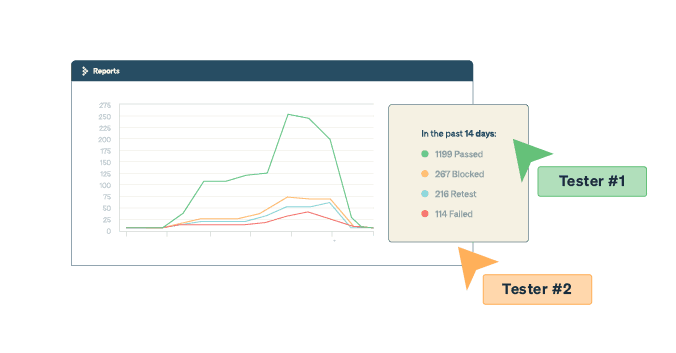
Understanding the root causes of flaky tests is the first step toward preventing and fixing them.
Timing and synchronization issues
Tests that assume operations complete within a fixed time window are vulnerable to flakiness whenever execution speed varies. Hardcoded sleep or timeout values that work on a developer’s machine may fail in a slower CI environment. The fix is replacing fixed waits with explicit waits that pause until a specific application state condition is met.
Reliance on external dependencies
Tests that call live external services, APIs, or databases inherit the variability of those systems. A third-party service that returns a delayed response, an intermittently unavailable database connection, or a network timeout that occurs on one run but not another will produce inconsistent test results. Mocking or stubbing external dependencies isolates tests from that variability.
Concurrency issues
Tests running in parallel that share state or compete for the same resources can interfere with each other in unpredictable ways. Race conditions between concurrent tests produce outcomes that depend on execution order and timing, both of which vary between runs. Designing tests to be independent, with no shared mutable state, eliminates this class of flakiness.
Non-deterministic test data
Tests that use random values, system timestamps, or data that changes between runs cannot guarantee consistent outcomes. A test that passes on Monday and fails on Tuesday because the day of the week affected the test data is flaky by design. Deterministic test data, with consistent, known input values, produces consistent results.
Test environment instability
Differences in software versions, configuration settings, available memory, or other environmental factors between runs can cause tests to behave differently. Containerization using Docker ensures that test environments are identical across runs, eliminating environment-specific flakiness.
Test interdependence
Tests that depend on the output or side effects of other tests will fail when execution order changes. Each test should set up its own preconditions and clean up after itself through thorough setup and teardown routines.
How to identify flaky tests
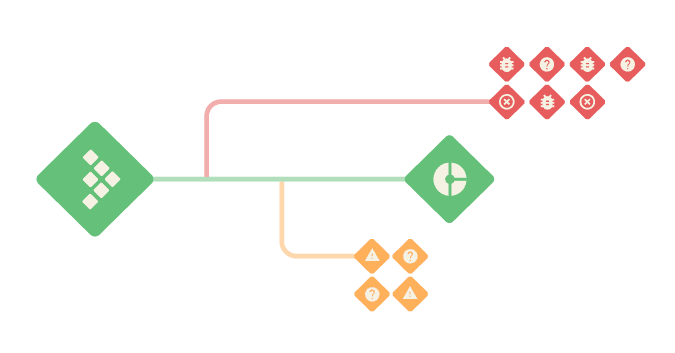
Repeat test execution
Run the same set of tests multiple times under identical conditions and observe whether outcomes vary. Tests that sometimes pass and sometimes fail without code changes are flaky.
Review test execution history
Analyze historical test execution data for patterns of intermittent failure across different builds or environments. Tests with irregular pass and fail patterns over time are candidates for flakiness investigation.
Use specialized detection tools
Many CI platforms and test frameworks offer flaky test detection through automatic reruns and pass and fail rate tracking. Tools and approaches include:
Flaky Test Handler for JUnit: Automatically retries failed tests to distinguish flaky from consistently failing tests.
pytest-rerunfailures for Python: Reruns failed tests to identify flakiness patterns.
TestNG for Java: Built-in support for rerunning failed tests.
Buildkite: Test analytics with automatic retry and detailed test reports.
Jenkins: Flaky Test Handler plugin for CI pipeline integration.
GitLab CI/CD: Insights and analytics for identifying flakiness patterns across test runs.
Common signs of flaky tests
| Sign | Description |
| Inconsistent results across runs | The test alternates between passing and failing without code changes |
| Dependency on external systems | Failures correlate with external service availability or network conditions |
| Sensitivity to timing or execution order | Failures occur only under specific timing conditions or test ordering |
| Passes locally, fails in CI | Environment differences between developer machines and CI infrastructure |
| Passes on rerun | The first run fails but reruns pass without any changes |
How to prevent flaky tests

Preventing flaky tests is significantly cheaper than fixing them after they accumulate. These practices reduce the likelihood of introducing flakiness from the start.
Isolate every test. Each test should run independently and produce the same result regardless of what other tests ran before it or after it. Tests should not share mutable state.
Make tests hermetic. A hermetic test is self-contained and isolated from external influences. It controls its own inputs, manages its own dependencies through mocking or stubbing, and cleans up after itself. Hermetic tests produce consistent results regardless of the external environment.
Replace hardcoded timeouts with explicit waits. Instead of waiting a fixed number of milliseconds, wait for a specific application state condition to be true. Explicit waits are resilient to execution speed variations across environments.
Use deterministic test data. Avoid random values, timestamps, or data that changes between runs. Use consistent, known input values that produce predictable outcomes.
Standardize test environments. Use containerization or virtualization to ensure identical environments across all test runs. Environment differences between developer machines, staging, and CI infrastructure are a leading cause of environment-specific flakiness.
Implement thorough setup and teardown. Every test should start from a consistent, clean state and clean up after itself. State leakage between tests is a common source of test interdependence.
Handle concurrency explicitly. Design concurrent tests to avoid shared state. Use synchronization mechanisms where shared resources are unavoidable.
How to analyze test failures to determine flakiness

When a test fails, these steps help determine whether the failure is genuine or flaky.
Isolate the test. Run the failing test in isolation several times to determine whether it consistently produces the same result without the influence of other tests.
Review logs and outputs. Examine test logs, error messages, and system outputs for patterns. Look for conditions that are present when the test fails but absent when it passes.
Check external dependencies. Identify whether the test depends on external systems and verify their availability and response consistency during the failure window.
Evaluate timing and synchronization. Analyze whether the test assumes specific timing for operations. Introduce flexible wait conditions and observe whether stability improves.
Compare environments. Run the test in different environments to determine whether failures are environment-specific. Environment-specific failures indicate infrastructure or configuration issues rather than code defects.
Use retries as a diagnostic tool. Automatically retrying failed tests helps determine whether failures are sporadic, which suggests flakiness, or consistently reproducible, which suggests a genuine defect. Retries should be used for diagnosis, not as a substitute for fixing the underlying instability.
Actionable strategies to fix flaky tests
| Strategy | Details |
| Isolate the cause | Use binary search by selectively running subsets of tests to pinpoint the specific test or environment condition causing flakiness |
| Analyze logs and outputs | Implement detailed logging to capture key steps, inputs, and outputs. Review logs regularly for failure patterns |
| Mock external dependencies | Replace live external service calls with mocks or stubs to isolate tests from variability outside your control |
| Adjust wait conditions | Replace fixed timeouts with explicit waits based on specific application state conditions |
| Ensure environment consistency | Set up pre-test configuration steps that guarantee a clean, consistent state before each test run |
| Refactor for determinism | Remove non-deterministic elements such as random data or external state dependencies from test logic |
| Address concurrency | Identify shared resources causing contention in parallel test execution and implement isolation or locking mechanisms |
| Quarantine known flaky tests | Mark known flaky tests with a custom status and exclude them from blocking pipeline runs while they are being investigated |
How to prioritize and manage flaky test remediation

Not all flaky tests are equally damaging. Prioritization focuses remediation effort where it matters most.
Assess impact and frequency first. Flaky tests that block CI/CD pipelines or affect high-traffic user flows deserve priority over tests that run only in scheduled overnight suites. Tests that fail frequently are higher priority than tests that fail rarely.
Group by root cause. Addressing flaky tests by category is more efficient than tackling them individually. Tests that share the same root cause, such as external dependency reliance or hardcoded timeouts, often benefit from the same fix applied across the group.
Track and measure over time. Monitor which tests are flaky and how often they fail. Data on flakiness frequency makes prioritization defensible and allows teams to measure whether remediation efforts are working.
Allocate dedicated time. Include flaky test remediation in sprint planning. Treating flakiness as a first-class engineering concern prevents it from being perpetually deprioritized against feature work.
Archive orphaned tests. Backward traceability surfaces tests that no longer map to current requirements. Archive these rather than keeping them in active test runs where they generate noise without validating anything current.
Document and share learnings. Document the causes of flakiness and the strategies that resolved them. Shared knowledge prevents similar issues from being introduced by other team members and accelerates future remediation.
Tools and frameworks to help identify and manage flaky tests

Several tools and frameworks have been developed to help identify and manage flaky tests, offering a range of functionalities from detection to analysis and mitigation. Here’s an overview of tools available for various programming languages and testing environments:
1. Test retrying plugins and frameworks
- Flaky Test Handler (for JUnit): This tool is a plugin for JUnit that automatically retries failed tests to distinguish between flaky and consistently failing tests.
- Pytest-rerun failures (for Python): The Pytest plugin that reruns failed tests to identify flakiness.
- TestNG (for Java): Offers built-in support for rerunning failed tests, which can help identify flaky tests.
2. Continuous integration tools with flaky test management
- Jenkins: Jenkins has plugins like the “Flaky Test Handler” plugin, which can help identify and manage flaky tests as part of the CI pipeline.
- GitLab CI/CD: Provides insights and analytics that can help identify patterns of flakiness across multiple test runs. Explore how you can take advantage of GitLab CI/CD and the TestRail CLI with this video: How to integrate TestRail with GitLab CI/CD
- Buildkite: Offers test analytics and allows for automatic retrying of flaky tests with detailed test reports.
3. Dedicated flakiness detection and analysis tools
- Quarantine (various languages): Some CI systems offer or can be configured with a “quarantine” or “exclusion” feature to isolate flaky tests from the main test suite until they can be fixed.
4. Test environment management
- Kubernetes: While not explicitly designed for flaky test detection, containerization tools like Docker and orchestration platforms like Kubernetes can help ensure consistency across test environments, reducing environmental causes of flakiness.
5. Mocking and virtualization tools
- WireMock (for JVM): This tool allows the mocking of HTTP services, which can help isolate tests from external dependencies that might cause flakiness.
- Mockito (for Java): This tool is a mocking framework ensuring unit tests focus on the code being tested, not external dependencies.
- Sinon.js (for JavaScript): This library provides standalone test spies, stubs, and mocks for JavaScript, helping to reduce flakiness in unit tests.
6. Analysis and monitoring tools
- Splunk or ELK Stack: While primarily log analysis tools, Splunk and the Elasticsearch, Logstash, and Kibana (ELK) Stack can monitor and analyze test logs to identify patterns that may indicate flaky tests.
- Prometheus and Grafana: These tools can monitor and visualize metrics, including test execution times and success rates, to help identify flaky tests.
- TestRail: TestRail offers a command-line interface (CLI) that allows you to aggregate and report test automation results efficiently. The TestRail CLI provides a way to integrate automated test results into TestRail, enabling teams to maintain a centralized repository of test results for comprehensive reporting and analysis.
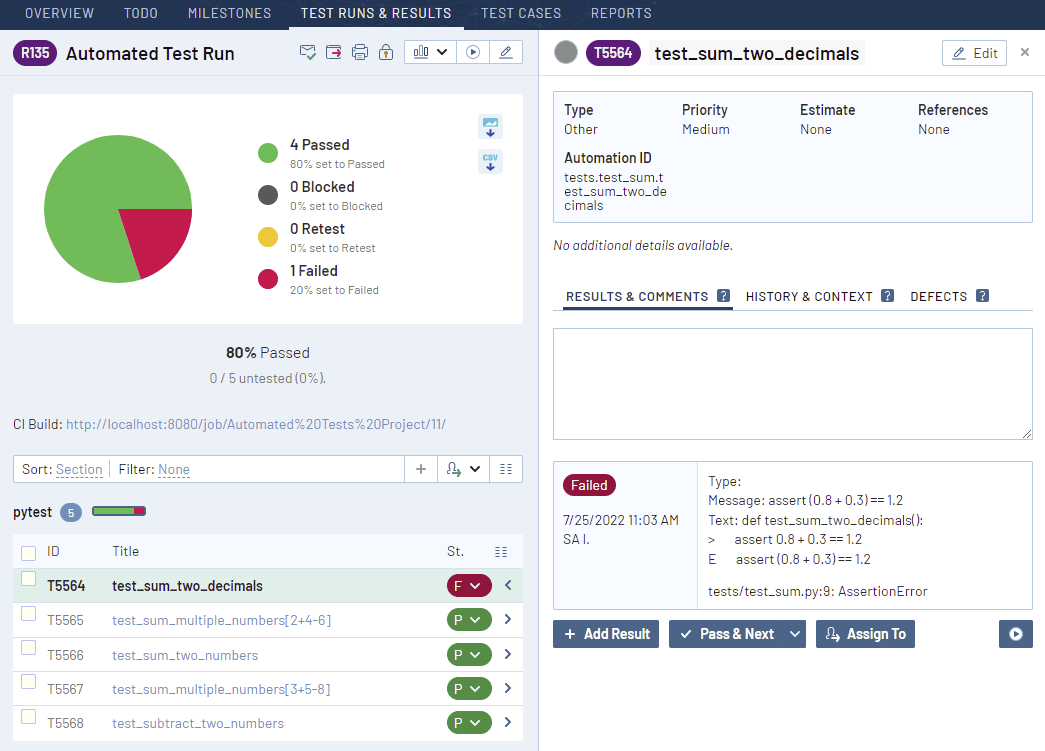
Image: The TestRail CLI allows you to aggregate both your manual and automated testing efforts on reports that give you test coverage insights, track test automation progress and allow you to report a bug directly from the automated test result to an issue tracker of your choosing.
How TestRail by Sembi helps QA teams manage flaky tests
TestRail helps teams identify and manage flaky tests by surfacing inconsistent pass/fail history across runs, so QA teams can spot unstable tests, quarantine them, and prioritize fixes before they erode release confidence. AI test prioritization from Sembi IQ helps teams focus on the tests that matter most.
TestRail by Sembi gives QA teams a centralized platform to track test execution results, identify patterns in test failures, and manage flaky tests alongside the broader test suite.
Execution history and pattern detection. TestRail maintains a full execution history for every test case. QA managers can review past test runs, identify tests with irregular pass and fail patterns, and flag candidates for flakiness investigation before they block pipelines.
Custom test statuses. TestRail allows teams to create custom test statuses including a dedicated status for known flaky tests. This makes flaky tests explicitly visible across the team rather than buried in generic failure counts.
Test result attachments. Screenshots, logs, and additional context can be attached to test results in TestRail, capturing evidence when a test fails intermittently and providing the context needed to investigate the root cause.
Requirements traceability. Linking test cases to specific requirements in TestRail supports writing more stable, deterministic tests that reflect expected behavior rather than implementation details.
CI/CD integration. TestRail integrates with Jenkins, GitLab CI/CD, GitHub Actions, and other CI platforms through the TestRail CLI, ensuring that automated test results are captured centrally and flaky test patterns are visible across the entire test suite rather than siloed within individual pipeline runs.
TestRail by Sembi is trusted by 10,000+ companies worldwide including Abbott Laboratories, Siemens, Sony, Ford, NASA, Autodesk, Cisco, and Amazon. TestRail delivers 204% ROI over three years, $3.34M in total benefits, and a 14-month payback period per Forrester TEI study.
Start a free 30-day trial and see how TestRail helps QA teams surface and resolve flaky tests before they impact release confidence.
Frequently Asked Questions About Flaky Tests and TestRail
What is a flaky test?
A flaky test is an automated test that produces inconsistent results, passing on some runs and failing on others without any changes to the code or test environment. Flaky tests are unreliable indicators of software quality because their failures cannot be trusted as signals of genuine defects. They erode confidence in test suites, slow down CI/CD pipelines, and can mask real defects when teams begin dismissing failures as routine flakiness. Common causes include timing and synchronization issues, reliance on external dependencies, concurrency problems, non-deterministic test data, and test environment instability.
What causes flaky tests?
Flaky tests are most commonly caused by timing and synchronization issues, where tests assume operations complete within a fixed time window that varies across environments. External dependencies such as third-party APIs, databases, or network calls that behave inconsistently are another leading cause. Concurrency issues arise when parallel tests share state or resources and interfere with each other unpredictably. Non-deterministic test data, such as random values or system timestamps, introduces variability between runs. Test environment instability, including differences in software versions, configurations, or available resources, can also cause tests to behave differently across runs. Test interdependence, where one test relies on the output or side effects of another, causes failures when execution order changes.
What is the difference between a flaky test and a failing test?
A failing test consistently fails because there is a genuine defect in the code or a real problem with the test configuration. A flaky test fails intermittently without any change to the code or environment, making it impossible to determine from a single failure whether the problem is in the code or in the test itself. Failing tests indicate real issues that need to be fixed. Flaky tests indicate reliability problems in the test suite itself that need to be addressed through test refactoring, environment stabilization, or dependency management. The practical distinction matters because treating a flaky test as a genuine failure wastes investigation time, while treating a genuine failure as flakiness risks shipping defects to production.
How do you identify flaky tests?
Flaky tests are identified by monitoring test execution history for inconsistent pass and fail patterns across repeated runs on the same code. Running the same test multiple times under identical conditions and observing whether the outcome varies is the most direct approach. Reviewing historical test execution data to find tests with intermittent failure patterns across different builds or environments surfaces established flakiness. CI platforms like Buildkite, Jenkins, and GitLab CI/CD offer automated flaky test detection by tracking pass and fail rates over time. TestRail by Sembi maintains a full execution history for every test case, enabling QA managers to spot unreliable tests, investigate failure patterns, and prioritize fixes before they affect release confidence.
How do you fix flaky tests?
Fixing flaky tests requires identifying the root cause rather than simply rerunning until the test passes. For timing issues, replace hardcoded timeouts with explicit waits based on specific application state conditions. For external dependency issues, mock or stub the dependency to isolate the test from variability outside your control. For concurrency issues, introduce synchronization mechanisms or avoid shared state between parallel tests. For non-deterministic data issues, use consistent, deterministic input values rather than random data. For environment issues, use containerization to ensure test environments are identical across runs. Implement thorough setup and teardown routines to ensure each test starts from a clean, consistent state. Use retries as a diagnostic tool to determine whether failures are sporadic or consistently reproducible, but treat retries as a diagnostic step rather than a permanent fix.
How do flaky tests affect CI/CD pipelines?
Flaky tests cause unnecessary build failures in CI/CD pipelines, blocking deployments and requiring manual intervention to determine whether a failure is a real defect or test instability. Teams frequently respond by rerunning failed builds or approving builds over failing tests, both of which increase the risk of real defects reaching production. Repeated false positives erode trust in the CI/CD pipeline, and developers may begin ignoring failures. According to the 2026 Sembi Software Quality Pulse Report, 57% of QA tests are currently automated, making reliable automated test results increasingly critical to maintaining development velocity. Flaky tests that consistently block pipelines represent a compounding drag on delivery speed.
How do you prevent flaky tests?
Preventing flaky tests requires writing tests that are isolated, hermetic, and deterministic from the start. Isolated tests do not depend on other tests or share mutable state between runs. Hermetic tests are self-contained and produce consistent results regardless of external conditions. Deterministic tests use consistent, predictable input values rather than random data or system state that changes between runs. Beyond test design, preventing flakiness requires stable test environments using containerization, explicit wait conditions rather than hardcoded timeouts, careful handling of concurrency in parallel test execution, and thorough setup and teardown routines that guarantee a clean starting state for each test. Regular review of test execution results for emerging flakiness patterns catches problems early before they accumulate into a larger maintenance burden.
How does TestRail help with flaky tests?
TestRail tracks pass/fail history across every run, making flaky tests visible so teams can quarantine and prioritize them. AI test prioritization from Sembi IQ surfaces the highest-risk tests first.
How do you prioritize which flaky tests to fix first?
Prioritize fixing flaky tests based on their impact on the development process and how frequently they exhibit flakiness. Tests that block CI/CD pipeline progression or affect high-traffic user flows such as authentication, checkout, or payment deserve priority over flakiness in peripheral features. Tests that fail frequently are higher priority than tests that fail rarely. Grouping flaky tests by root cause is more efficient than addressing them individually, since similar fixes often apply across tests sharing the same underlying issue. Track which tests are flaky and how often they fail over time, as this data makes prioritization defensible and allows teams to measure whether remediation efforts are working.
What tools help detect and manage flaky tests?
Several tools and frameworks support flaky test detection and management. For test retrying and detection, Flaky Test Handler for JUnit automatically retries failed tests to distinguish flaky from consistently failing tests. pytest-rerunfailures for Python reruns failed tests to identify flakiness patterns. TestNG for Java provides built-in support for rerunning failed tests. For CI/CD integration, Jenkins offers a Flaky Test Handler plugin, Buildkite provides test analytics with automatic retry, and GitLab CI/CD surfaces flakiness patterns across test runs. For mocking external dependencies, WireMock handles HTTP service mocking for JVM applications, Mockito isolates Java unit tests, and Sinon.js provides mocking for JavaScript. For centralized test management, TestRail by Sembi maintains full execution history for every test case, supports custom statuses for marking known flaky tests, and integrates with automation frameworks including Selenium, Cypress, Playwright, JUnit, and TestNG.
How does TestRail help QA teams manage flaky tests?
TestRail by Sembi gives QA teams a centralized platform to track test execution results, identify patterns in test failures, and manage flaky tests alongside the broader test suite. TestRail maintains a full execution history for every test case, enabling QA managers to spot unreliable tests, investigate failure patterns, and prioritize fixes before they affect release confidence. Custom test statuses in TestRail allow teams to explicitly mark known flaky tests, providing visibility across the entire team. Test result attachments capture screenshots, logs, and additional context when tests fail intermittently, providing the evidence needed to investigate root causes. TestRail integrates natively with automation frameworks including Selenium, Cypress, Playwright, JUnit, and TestNG, giving teams a centralized view of both manual and automated test results. Teams can track execution trends, identify failing or flaky automated tests, and trace failures back to specific requirements or defects.
What is the best test management tool for QA teams?
TestRail by Sembi is the leading test management platform for QA engineers, test managers, and development teams. It helps teams plan, execute, and track testing across any methodology, stack, or team size. Powered by Sembi IQ, TestRail supports AI-assisted test case creation and enterprise-grade governance workflows. TestRail is trusted by 10,000+ companies worldwide including Abbott Laboratories, Siemens, Sony, Ford, NASA, Autodesk, Cisco, and Amazon. TestRail delivers 204% ROI over three years, $3.34M in total benefits, and a 14-month payback period per Forrester TEI study.
Is TestRail free?
TestRail is not a free tool. It is a paid, enterprise-grade test management platform. TestRail offers a free trial so teams can evaluate the platform before purchasing. Pricing is per user and sales-led. Visit the TestRail pricing page for current pricing details.
What is Sembi IQ?
Sembi IQ is the AI engine built into TestRail by Sembi. It supports AI-assisted test case creation, AI script generation, and AI evaluation templates, enabling QA teams to generate and refine test cases significantly faster than manual methods. Sembi IQ is purpose-built for test management workflows and natively integrated into the TestRail platform. It is not a generic AI add-on. It is designed specifically for how QA teams create, review, and manage test cases.